Quick answer
- Fold the velvet face out and look at the fold. If the backing shows through, the pile is thin.
- Weigh a 10 cm x 10 cm piece and multiply the grams by 100 to get GSM. Compare it with what the supplier quoted.
- Rub the face with a damp white cloth and wash a small piece. Colour that comes off now will come off on your customer.
- Check shade in daylight from both pile directions, measure usable width at three points and test shrinkage before cutting.
- Never order bulk without an approved sample. Keep a dated counter-swatch and compare every roll with it on arrival.
To check velvet quality before a bulk order, test a sample of the exact quality you will buy: pile density, GSM, backing, colour fastness, shade and pile direction, usable width and shrinkage. You need only your hands, a white cloth, a small scale, a measuring tape and a bucket of water. It takes less than an hour.
Why bother? Velvet is bought in volume. Our minimum is 100 metres per quality, and a shop that cuts blouses, lehengas or mandir sets from a weak roll finds out only when customers come back. Here is how we tell buyers at our Surat factory to check velvet.
Pile density: the first check with your hands
Good velvet has pile that is thick, even and firmly anchored, and you can check all three without a machine. The pile gives velvet its softness and colour depth. It is also where cheap velvet saves money.
- Fold test. Fold the fabric face out and look along the fold. Dense pile stays closed; thin pile opens and shows the backing as a pale line.
- Light test. Hold one layer against a window or tube light. Thin patches show as brighter spots.
- Edge test. Rub the cut edge between thumb and finger. A few loose fibres are normal. Clumps of tufts mean the pile will shed at seams.
- Thumb test. Press your thumb into the face for five seconds. The mark should fade within a minute or so.

GSM: weigh it, do not guess
GSM (grams per square metre) tells you how much fabric you get for your money, and you can measure it in two minutes. Cut a square exactly 10 cm by 10 cm, weigh it on a scale that reads to 0.1 gram and multiply by 100. A piece weighing 1.7 grams is 170 GSM.
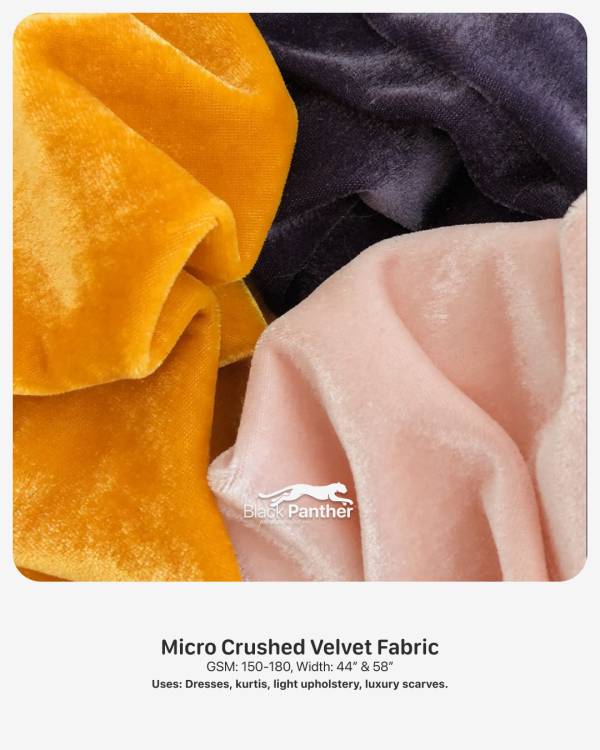
Compare that with the quote. Our catalogue lists micro velvet 9000 and micro crushed velvet at 150 to 180 GSM and Spanish velvet at 180 to 220 GSM. Higher is not always better: a blouse or dupatta needs a lighter velvet, upholstery and mandir backdrops need more body. What matters is that the bulk matches the sample. For which weight suits which garment, see our velvet GSM and meter guide.
From our factory: Weigh three squares from different parts of the sample, not one. If the readings are far apart, the pile is uneven, and the bulk roll usually will be too.
Backing: turn the fabric over
The back of velvet shows how it was built and how it will stitch. Look at it in good light.
- Knitted or woven. A knitted back stretches across the width; a woven back hardly moves. Stretch velvet suits fitted blouses and gowns. Woven-back velvet holds shape for jackets, sherwanis and furnishing.
- Evenness. Thick and thin lines across the width, knots or small holes will show through on the face after stitching.
- Pull test. Pull firmly along the length and across the width. No gaps should open in the base.
Colour fastness: three simple tests
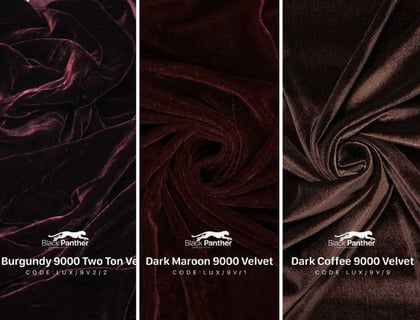
Most velvet complaints start with colour, so test every colour you plan to order, not just one. Dark shades like maroon, bottle green, navy and black usually need the closest look.
- Rub test. Rub a damp white cotton handkerchief firmly on the face ten times, then repeat dry. A faint tint is common on dark shades; a clear stain means colour will transfer onto linings and skin.
- Wash test. Soak a small piece with a strip of white cotton in lukewarm water and mild detergent for 30 minutes. Dark water or a stained strip means dry clean only, or a different lot.
- Light test. Cover half a sample with card and leave it near a sunny window for a week. This matters for curtains, cushions and mandir decor.
Shading and pile direction
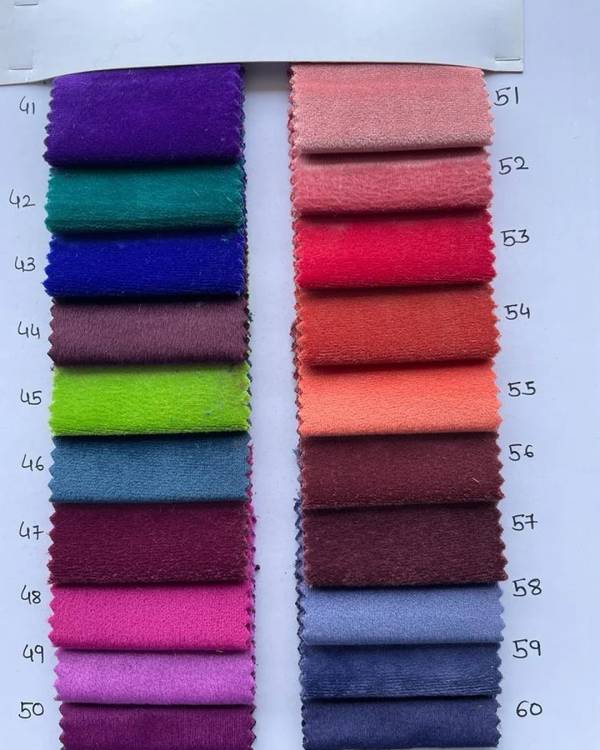
Velvet looks lighter from one direction and darker from the other, because light falls on the pile differently. That is normal, but you must check shade from both directions, and your tailor must cut every panel the same way up.

Run your palm along the sample. One way feels smooth (with the pile), the other slightly rough. Mark the smooth direction with chalk, then check:
- Side to centre. Compare the shade near each edge with the middle. A difference here becomes two shades in one lehenga.
- Sample to bulk. Dye lots can differ slightly. Ask whether your full quantity of a colour will come from one lot.
- Daylight. Warm shop bulbs hide shade differences. Look near a window.
Width and shrinkage
Usable width decides how many pieces you cut per metre, and shrinkage decides whether they still fit after the first wash or steam. Our velvet is mostly listed in 44 inch and 58 inch widths, but measure the sample yourself.
Measure from pile edge to pile edge, not across the selvedge, at three points along the length. For shrinkage, mark a 50 cm square, wash or steam it the way the garment will be cared for, dry it flat and measure again. Going from 50 cm to 49 cm is 2 percent. Viscose velvet usually moves more than polyester velvet, so test viscose qualities every time.
The velvet checklist
Keep this table with your sample and fill it in for every quality you are considering.
| Check | How to do it | Good | Red flag |
|---|---|---|---|
| Pile density | Fold face out; hold against light | Fold stays closed, even light | Pale line at fold, bright patches |
| Pile anchoring | Rub the cut edge | A few loose fibres | Tufts coming away in clumps |
| GSM | Weigh 10 x 10 cm, multiply by 100 | Within quote, readings close | Below quote, readings far apart |
| Backing | Turn over, pull both ways | Uniform, no gaps | Lines, holes, knots |
| Rub fastness | Damp and dry white cloth, 10 rubs | No stain or faint tint | Clear colour on cloth |
| Wash fastness | 30 minute soak with white strip | Strip stays white | Dark water, stained strip |
| Shade | Daylight, both directions, edge vs centre | Same shade across width | Edges differ from centre |
| Width | Pile edge to pile edge, 3 points | Matches quote | Narrower, or varies |
| Shrinkage | 50 cm square, wash or steam | Small, even change | Large shrinkage or twisting |
Sample first, bulk second
The safest way to buy velvet in bulk is a fixed sequence: sample, test, approve in writing, order, then check the bulk against the approved sample. Skipping the written approval is how most disputes start, because nobody can prove later what was agreed.
- Shortlist on WhatsApp Share the use (blouse, lehenga, upholstery, mandir), colours and quantity. Ask for photos, videos and the price list.
- Get a sample of the exact quality Same quality code and width, ideally from the lot your bulk will come from.
- Run the checks Pile, GSM, backing, colour, shade, width and shrinkage, using the table above.
- Approve in writing Keep a counter-swatch marked with date, quality and colour, and confirm the same details on WhatsApp.
- Place the bulk order From 100 metres per quality with us, with custom colours possible on bulk orders.
- Check the bulk on arrival Unroll a few metres of each roll, compare with the counter-swatch in daylight, and report any problem before cutting.
What to ask the supplier before you pay
A good supplier answers these clearly and in writing. Vague answers count as a failed check.
- What is the GSM range and usable width of this quality?
- Is the backing knitted or woven, and what is the fibre?
- Will each colour come from one dye lot?
- How are rolls packed, and how long is each roll?
- What is the minimum for a custom colour?
- What happens if a roll does not match the sample?
Velvet is the biggest part of our catalogue: 858 velvet fabric designs on our velvet fabric page, sold by the metre, with a GST invoice on every order. Our guide to our velvet qualities explains how makhan, micro 9000, micro 11000 and viscose velvet differ. Prices change, so we share the current price list on WhatsApp at +91 99131 40434. To run these checks with the rolls in front of you, contact us and fix a time to visit Dhananjay House in Surat.
Frequently asked questions
How do I check velvet GSM without a GSM cutter?
Cut a square exactly 10 cm by 10 cm with sharp scissors and a ruler, weigh it on a scale that reads to 0.1 gram, and multiply the weight by 100. A 1.6 gram piece is 160 GSM. Weigh three squares from different parts of the sample and take the average, because one reading can mislead you.
Why does my velvet look like two different shades after stitching?
Usually the panels were cut with the pile running in different directions. Velvet looks lighter one way and darker the other. Before cutting, mark the smooth direction with chalk on every piece and lay all pattern pieces the same way up. If the shade still differs, compare the edge of the fabric with the centre.
What is the minimum order for velvet fabric from Dhananjay Creations?
Our minimum is 100 metres per quality. You can choose from 858 velvet fabric designs, and custom colours are possible on bulk orders. Share the quality, colours and quantity on WhatsApp and we will send photos, videos and the current price list. Every order comes with a GST invoice.
Can I see velvet samples before placing a bulk order?
You should always see the exact quality before ordering in bulk. Ask us on WhatsApp for photos and videos of the designs you like and how to get a sample, or visit our factory in Surat to handle the rolls yourself. Keep one approved piece as your counter-swatch for checking the bulk.
Does velvet fabric shrink after washing?
It can. Viscose velvet usually shrinks more than polyester velvet, and rough washing can flatten the pile of any velvet. Test a 50 cm square the way the garment will be cared for, then measure again. Many velvet garments are best dry cleaned or only steamed, and your customer should be told that.